Deal governance
The information problem is a governance problem
Deal data has always been scattered across inboxes, chat threads and private spreadsheets. AI has made it worse, not better. Lens puts the whole deal under one governed record — structured, permissioned, cited and auditable.
Where the evidence actually lives
Everywhere, and therefore nowhere
Ask a deal team where the answer to a diligence question sits and you will get four different answers. This has been true for decades. The cost is not tidiness — it is decisions taken without the evidence that was already in the building.
Inbox
The decisive attachment sits in one person's mailbox. Nobody else knows it exists, and it never reaches the workstream it belongs to.
Teams and Slack
Findings are argued out in threads that no one can search six weeks later, let alone six months after completion.
Spreadsheets
The tracker is a private copy. Two versions disagree, and the one on the call wins regardless of which is right.
Shadow AI
Confidential documents are pasted into general chat assistants with no project scope, no access control and no record of what was asked or answered.
What it costs
The right people don't get the right information
A red flag surfaced in week two reaches the investment committee in week six. An integration lead inherits a report instead of the reasoning behind it. A value creation plan is built on what someone remembers rather than what was found. None of this is a people failure — it is the absence of a system of record.
- Findings arrive late, or arrive without the evidence that made them credible.
- Confidential material moves through channels nobody can audit.
- Institutional memory leaves with whoever ran the last deal.
What governance looks like in practice
Structure, permission, provenance
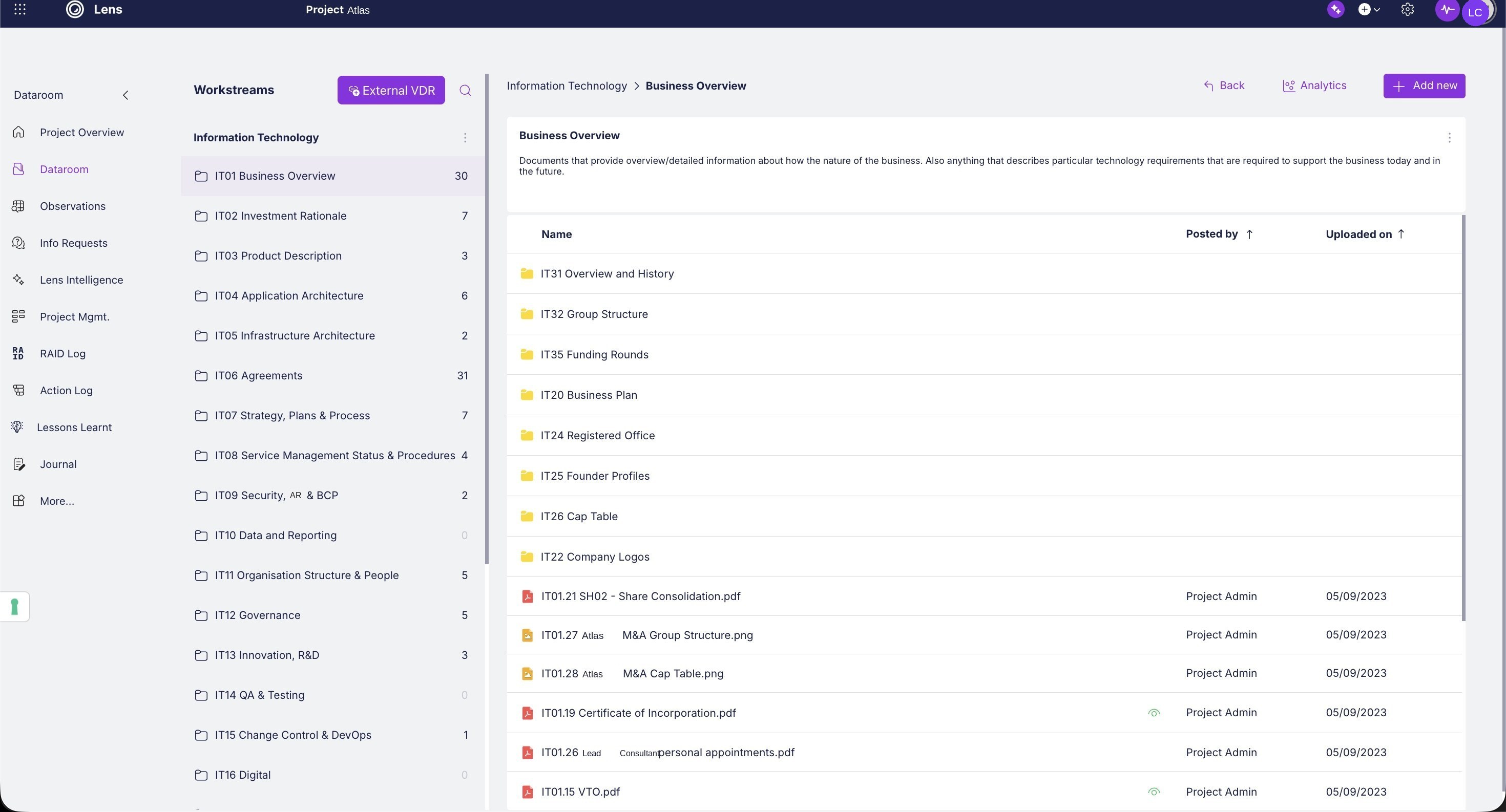
Governance is not a policy document. It is the four things below being true by default on every deal, without anyone having to remember to do them.
One structured record
Every document, request, observation and note is filed against a numbered workstream. There is one place a finding can live, so there is one place to look for it.
Right people, right information
Role and workstream-level permissions mean the commercial lead sees the commercial evidence, the target responds without seeing internal analysis, and nothing critical stalls in a private thread.
Governed AI, not shadow AI
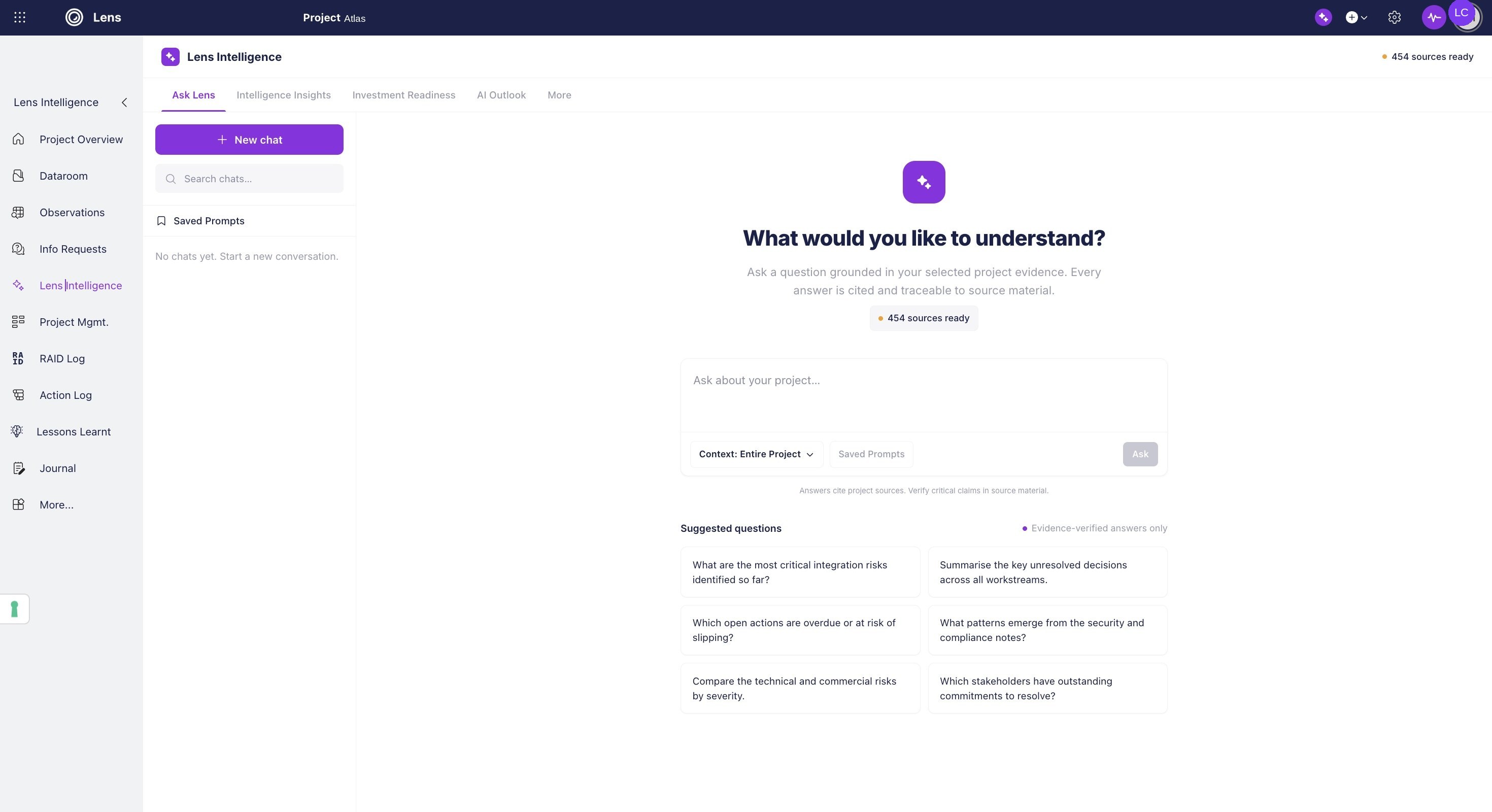
Ask Lens reads only the sources a human has explicitly scoped to it, cites what it used and is versioned for review. Analysts stop pasting the dataroom into consumer chatbots.
A defensible audit trail
Uploads, reads, responses, changed observations and generated artefacts all carry an actor and a timestamp — so a conclusion can still be evidenced when the board asks a year later.
AI without the governance gap
Most firms are assessing deals in a chat window
General assistants are genuinely useful and completely ungoverned: no project scope, no permissions, no record of the prompt, no citation for the answer. Lens keeps the usefulness and adds the controls — scoped context, named sources, confidence labelling and human review before anything is relied on.
Why it matters after completion
Governed evidence is what value creation runs on
The diligence record is the raw material for the integration plan and the value creation programme. If it was never governed, it cannot be carried forward — and the second year of ownership starts from a blank page.
IT01–16
Workstreams every finding is filed against
1
Record carried from diligence into integration and value creation
100%
AI answers returned with their source set
0
Confidential documents pasted into ungoverned chat tools
Related
How the controls are implemented
Access control, project isolation, retention and the audit trail are set out in detail on the Security & Trust page.
See what a governed deal record looks like
A 30-minute walkthrough of diligence, integration and value creation in one system.